
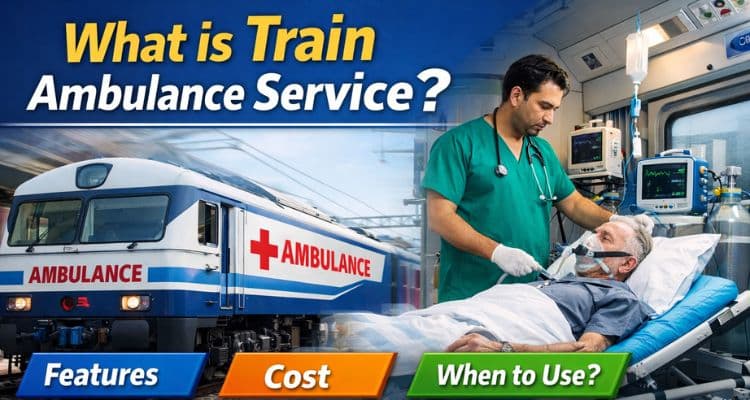
India’s best medical specialists are concentrated in a handful of metro cities, while millions of patients live hundreds of kilometres away from the treatment they need. For families facing this gap, a train ambulance service has become one of the most practical ways to move a critically ill patient safely, comfortably, and affordably across long distances. This guide covers everything you need to know before booking one.
What Is a Train Ambulance?
A train ambulance service is a medical transportation service that uses trains to move patients over long distances, equipped with medical facilities so critical patients receive care at every stage of the journey.
Rather than being a separate railway service, it works through a private medical provider booking a berth or coupe on an existing train and converting it into a mobile intensive care unit for the duration of the trip.
How Does a Train Ambulance Work?

Each train ambulance unit is staffed by a dedicated doctor and paramedic who provide continuous vital monitoring and support from hospital pickup to destination handover.
The journey typically runs in four stages:
- Road ambulance pickup – A road ambulance collects the patient from home or the referring hospital and takes them to the nearest railway station.
- Transfer to the train coach – At the station, the patient is shifted into the pre-equipped compartment where the medical team is already stationed.
- In-transit monitoring – The doctor and paramedic track vitals and manage equipment throughout the journey.
- Arrival and handover – A second road ambulance takes the patient from the destination station directly to the receiving hospital, completing the bed-to-bed transfer.
Who Needs Train Ambulance Services?
Train ambulance services are ideal for patients requiring intercity hospital transfers, post-surgical or chronic care patients needing ICU support, and those who cannot travel by air due to cost or condition.
Typical situations include:
- Intercity transfers – between hospitals in different cities for specialised treatment
- Post-surgical or chronic care patients – needing ICU support during travel
- Patients who can’t fly – due to cost or medical condition
- Neonatal and paediatric patients – requiring incubator support
- Long-distance referrals – patients being sent to metro hospitals under medical supervision
Train ambulance services are a particularly strong alternative for critical patients needing long-distance evacuation from cities with stable rail networks, since good rail connectivity often gives faster and more reliable access to major hospitals than trying to arrange other transport.
Choose this option specifically when a road ambulance would be too uncomfortable for the distance and an air ambulance is out of budget — it’s best suited to scheduled, bed-to-bed transfers that need supervision but aren’t a minutes-matter emergency.
What Equipment and Medical Staff Travel Onboard?
A train ambulance is equipped with the same core life-support tools found in a hospital ICU, accompanied by a qualified clinical team for the entire journey.
Equipment typically includes:
| Equipment | Purpose |
| Ventilators (adult & paediatric) | Respiratory support for critical patients |
| Defibrillator | Emergency cardiac response |
| Multipara cardiac monitors | Continuous vitals tracking |
| Oxygen cylinders | Oxygen therapy during transit |
| Suction machines | Airway management |
| Infusion pumps | Controlled IV medication delivery |
| Emergency drugs | Immediate response to complications |
Staff onboard usually include a qualified nurse, paramedic, or doctor, with military-trained professionals available for higher-acuity cases. This team stays with the patient for the full duration of the trip, not just at pickup and drop-off, ensuring continuous bed-to-bed care.
Types of Train Ambulance Coach Classes
The coach class you choose affects privacy, comfort, and cost, with AC First Tier offering the most space and AC Third Tier being the most economical.
| Coach Class | Privacy | Space | Typical Use Case |
| AC 1st Tier | High (private coupe) | Most spacious | Critical patients needing ventilator/ICU setup |
| AC 2nd Tier | Moderate | Adequate for equipment | Stable-critical patients under supervision |
| AC 3rd Tier | Lower | Compact | Budget-conscious, less equipment-heavy transfers |
Train Ambulance vs Road Ambulance vs Air Ambulance
A train ambulance sits in the middle ground: it’s more comfortable and better suited to long distances than a road ambulance, and considerably cheaper than an air ambulance.
| Factor | Road Ambulance | Train Ambulance | Air Ambulance |
| Best for distance | Short (under 100-500 km) | Long (500+ km) | Very long / cross-country |
| Cost | Lowest | Moderate | Highest |
| Speed | Slowest over long distances | Moderate | Fastest |
| Comfort | Prone to road jolts, noise | Smooth, air-conditioned, spacious | Pressurised cabin, minimal turbulence |
| Ground transfer needed | No | Yes (station to hospital both ends) | Yes (airport to hospital both ends) |
| Suitability for critical patients | Limited over long trips | Good, with full ICU setup | Best for extremely time-critical cases |
Long-distance patient transfer by train is typically used for inter-hospital transfers of more than roughly 500 km, where a rapid, low-vibration mode of transport helps keep the patient stable. Air transfer is sometimes used instead for very long or cross-country distances, offering a pressurised cabin and less noise — though it still needs additional ground transport between the airport and the hospital on both ends, the same limitation that applies to train ambulances at the station-to-hospital stage.
What Is the Cost of a Train Ambulance in India?
Cost varies based on distance, urgency, coach class, and the level of medical staffing and equipment required, so most providers give a customised quote rather than a flat rate.
Key factors that influence the final cost:
- Distance travelled – longer routes mean higher coach booking and staffing costs
- Coach class – AC 1st Tier costs more than AC 2nd or 3rd Tier
- Medical team composition – a doctor plus paramedic costs more than a paramedic alone
- Equipment needs – ventilator or neonatal incubator setups add to the cost Urgency – last-minute bookings can carry a premium over pre-scheduled transfers
Also READ: Understanding Train Ambulance Pricing: What You’re Really Paying For
How to Book a Train Ambulance: A Quick Checklist
Booking a train ambulance is straightforward if you have the patient’s medical details and travel information ready before contacting a provider.
Before you call, keep this ready:
- Patient’s current medical condition and any equipment they’re currently on (ventilator, oxygen, etc.)
- Current location and pickup hospital/address
- Destination hospital and city
- Preferred travel date and any time constraints
- Any special requirements (neonatal incubator, isolation needs, etc.)
Before confirming a booking, verify:
- The qualifications of the doctor and paramedic assigned
- The exact equipment list that will be onboard
- Whether road ambulance pickup and drop-off are included
- Total cost breakdown, including any last-minute or urgency charges
Also READ: How Critical Patients Are Shifted Safely by Train Ambulance in Patna
Challenges and Limitations of Train Ambulance Services
Train ambulances are safe and effective, but they do come with a few practical limitations worth knowing before you book.
- Fixed schedules and routes – you’re working within existing train timetables, which can limit flexibility for extremely time-sensitive cases.
- Ground transfer time – the station-to-hospital leg on both ends adds time compared to a direct hospital-to-hospital transfer.
- Seat/berth availability – during peak travel seasons, securing the right coach class at short notice can be harder.
Frequently Asked Questions
Is train ambulance safe?
Yes, train ambulances are a safe and reliable transport option for critically ill patients, with ICU-grade equipment and a professional doctor and paramedic monitoring vitals throughout the journey.
Can ICU patients travel by train?
Yes, train ambulances are designed to accommodate patients with a wide range of medical conditions, including those requiring full ICU-level support.
Can ventilator patients travel by train?
Yes, ventilator patients can travel by train ambulance, since each unit is fitted with ICU-level equipment like ventilators and monitors to support critical patients throughout the journey.
Can cancer patients travel by train ambulance?
Most cancer patients can travel safely, provided they plan ahead and get their oncologist’s approval first. The key factors are how recent the treatment was, current blood counts, and whether the trip falls during chemotherapy or in a recovery window.
Can newborn babies travel in train ambulance?
Yes, neonatal train ambulances are designed for the safe transport of infants as light as 500 grams, using incubators and paediatric-specific equipment.
How are oxygen patients transported?
Oxygen-dependent patients travel with a continuous onboard oxygen supply, monitored throughout the journey by the accompanying medical team to keep levels stable.
What is bed-to-bed patient transfer?
Bed-to-bed (or bedside-to-bedside) service refers to medical transport that covers the entire journey — from the patient’s current bed in a hospital, home, or care facility, to the receiving facility’s bed, under continuous medical supervision throughout.
Is train ambulance available across India?
Yes, a train ambulance is a medically equipped railway compartment that enables long-distance patient transfers across India, with fully staffed services available nationwide for both emergency and planned transfers.
Is train ambulance service covered by insurance?
Coverage varies by insurer and policy, so it’s best to check directly with your health insurance provider about reimbursement for train ambulance transport.
Conclusion
For a country as geographically vast as India, a train ambulance fills a genuine gap between an uncomfortable, slow road journey and an expensive air transfer. It offers ICU-level care, continuous medical supervision, and nationwide reach at a fraction of the cost of flying — making it one of the most practical options for long-distance, non-emergency patient transfers. If you’re planning a transfer for a loved one, get in touch with a qualified train ambulance provider early so the right coach class, equipment, and medical team can be arranged well ahead of your travel date.
Contact Save Life Care at +91-8083309381 to book your train ambulance service or discuss your patient’s specific requirements.