When families start comparing medical transport options, train ambulance pricing is usually the first thing they want explained. That makes sense: long-distance patient transfers in India are growing, and for many families, a train ambulance feels more practical than a road ambulance for very long journeys and far more affordable than an air ambulance. Provider-published price references also show that train ambulance quotes can vary widely—from roughly ₹40,000–₹90,000, to starting ICU setups at ₹70,000 for semi-ICU and ₹90,000 for full ICU, and in broader cases up to ₹2.5 lakh depending on the route and medical setup.
The biggest confusion for families is simple: why does one train ambulance cost look completely different from another? The answer is that you are not just paying for a train ticket. You are paying for an ICU-style medical transfer, trained manpower, railway coordination, patient handling, and the level of monitoring required during the journey. In other words, the price is shaped by the patient’s condition and the logistics needed to move that patient safely.
What is a Train Ambulance?
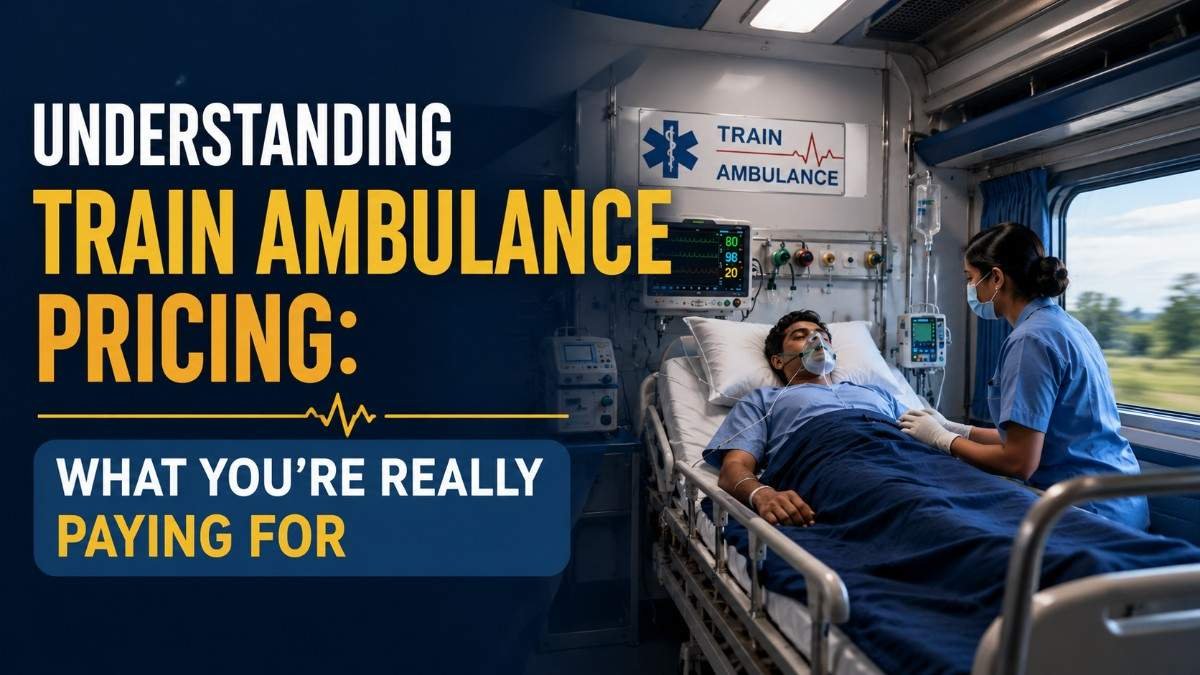
A train ambulance is a medical transfer service that uses the railway network to move a patient over long distances with medical support onboard. In practice, providers like Save Life Care convert an AC 1st tier or AC 2-tier compartment into an ICU-like space with life-support equipment, medical staff, and continuous monitoring during the trip. Many providers describe it as a bed-to-bed transfer service, meaning the patient is moved from the source hospital or home, handed over at the station, transported by train, and then shifted again to the destination hospital.
Depending on the case, the onboard setup may include a ventilator, oxygen cylinders, suction pumps, cardiac monitor, emergency medicines, and infusion or syringe pumps. Providers also distinguish between basic medical train transfers, semi-ICU train ambulances, and full ICU train ambulances based on how advanced the care needs are.
Why Train Ambulance Costs Are Different for Every Patient
There is no fixed price tag for every case because train ambulance services are customized. The cost changes according to the route, the patient’s condition, the level of ICU support required, the number of attendants, and the type of coach that can be arranged. Provider pages repeatedly describe pricing as variable rather than flat, which is exactly why families often receive different quotes for seemingly similar routes.
Think of it less like booking a seat and more like arranging a moving ICU. A stable patient may need only oxygen and basic monitoring, while a ventilator-dependent or otherwise critical patient may need a larger medical team and more equipment throughout the journey. That is where the price difference begins.
Main Factors That Affect Train Ambulance Pricing
1) Distance Between Cities
Longer routes generally cost more because they require more coordination, more medical time, and more logistical planning. Provider pricing examples show that even when some routes are quoted in a similar range, the underlying operational complexity still rises with distance and journey duration. For example, published estimates for routes such as Patna to Delhi and Kolkata to Delhi are often quoted in the ₹45,000–₹55,000 range by one provider, while other provider references still place overall train ambulance pricing much higher when ICU needs increase.
2) Type of Medical Setup Required
A semi-ICU setup costs less than a full ICU setup, and a ventilator-supported case usually costs more because it needs advanced equipment and tighter monitoring. One provider lists starting costs of ₹70,000 for semi-ICU and ₹90,000 for full ICU, which gives families a useful sense of how quickly the quote changes once the care level changes.
3) Patient’s Medical Condition
A stable post-surgery patient is very different from a cardiac, neuro, trauma, neonatal, or ventilator patient. Critical cases need experienced doctors, nurses, and paramedics who can respond immediately if the patient deteriorates. Providers describing train ambulance services consistently highlight continuous monitoring and ICU-level care for severely ill patients.
4) Number of Medical Staff
The more serious the case, the bigger the team usually needed. A basic transfer may need fewer staff, but a critical transfer may require a doctor, critical care nurse, EMT or paramedic, and sometimes additional technical support. Since provider pricing is tied to medical staffing and journey supervision, this is one of the major reasons quotes vary.
5) Train Class & Cabin Availability
Train ambulance teams typically work with AC 1st tier or AC 2-tier accommodation because the compartment must be spacious enough for the medical setup and safe patient handling. Availability also affects pricing: urgent reservation requirements, special coach coordination, and time-sensitive bookings can all increase the operational burden.
6) Pickup & Drop Ambulance Charges
A true train ambulance quote usually includes more than the rail journey itself. The patient still has to be moved from the hospital or home to the station, and then from the destination station to the receiving hospital. That bed-to-bed chain is part of the service, and it adds to the total cost.
7) Emergency or Last-Minute Booking
Urgent transfers can raise costs because the provider has less time to arrange the right coach, coordinate with rail logistics, and assemble the right team. Train ambulance pricing articles and air ambulance pricing guides alike point out that urgency increases operational complexity and therefore cost.
What’s Usually Included in Train Ambulance Charges?
Most families think they are only paying for travel, but the bigger cost is the medical care built into the journey. A standard train ambulance quote commonly includes the ICU-style setup inside the compartment, oxygen support, cardiac monitoring, ventilator support where required, medical consumables, doctor and paramedic supervision, patient handling, coordination support, emergency medicines, and basic railway arrangements.
That is why train ambulance charges in India can feel expensive at first glance. The train is only one part of the cost. The real value is the medical infrastructure running inside it.
Hidden Charges Families Often Don’t Know About
This is where transparency matters most. Some quotations may not fully include every extra requirement, andprovider pages note that additional expenses can apply for specific medical needs, medicines, and accompanying attendants. Before confirming a booking, families should ask whether the quote covers extra oxygen use, additional medicines, station handling, extra equipment, waiting time, and the return cost of the medical team if applicable.
A good provider will give a clear, itemised breakdown rather than a vague total. That simple step can prevent surprises later.
ICU Train Ambulance vs Air Ambulance: Price Comparison
| Service Type | Approx Cost | Best For |
| Road Ambulance | Lower for short distances | Nearby transfers and short intercity trips |
| Train Ambulance | Around ₹40,000–₹90,000 in many provider references; some publish ₹45,000–₹55,000 route examples and ₹70,000/₹90,000 starting ICU setups | Long-distance ICU transfer for stable critical patients |
| Air Ambulance | Usually starts around ₹1.5 lakh and can go up to ₹8 lakh or more domestically | Extreme emergencies and cases where speed is the top priority |
This is why train ambulance is often seen as the middle-ground solution. It gives families long-distance medical transport with ICU support at a much lower cost than air ambulance services, which is especially important for middle-class families balancing safety and affordability.
Why Cheap Train Ambulance Services Can Be Risky
The cheapest quote is not always the safest option. A low price can sometimes mean poorly trained staff, outdated equipment, weak coordination, or hidden costs that appear later. Since train ambulance services depend so heavily on medical expertise and careful logistics, a bargain quote that cuts corners can become a serious risk for the patient.
Questions You Should Ask Before Paying for a Train Ambulance
Before you confirm any booking, ask whether a doctor will travel with the patient, what ICU equipment is included, whether oxygen backup is guaranteed, whether pickup and drop ambulance legs are included, whether the quote is final or only estimated, and how the team handles railway delays. These questions help you compare real value instead of just comparing headline prices.
How to Choose the Right Train Ambulance Service
Choose a provider based on medical expertise, equipment quality, patient-handling experience, response time, transparency, and 24/7 coordination support. Providers that clearly explain the ICU setup, the staffing, and the route logistics are usually easier to trust than those that only advertise a low number.
Why Families Across India Prefer Train Ambulance for Long-Distance Transfers
Families often choose train ambulance because it is more affordable than air ambulance, safer than a very long road journey, and better suited for a spacious ICU setup. The railway option also gives the medical team a stable environment to monitor the patient continuously during long-distance movement.
Conclusion
When you look closely, train ambulance pricing is not really about the train ticket. It is about ICU care, medical staffing, patient safety, and the logistics needed to move a critically ill person from one hospital to another without compromising treatment. The best quote is not always the lowest one; the best choice is the one that is transparent, medically sound, and built around the patient’s condition.
Always choose a train ambulance provider that prioritizes patient safety, experienced medical staff, and transparent pricing.
At Save Life Care, we believe every patient deserves safe, transparent, and medically supervised transportation — because critical care should never be compromised by cost alone.