The Call That Changes Everything
It’s 2 AM. A family member in Patna has just been stabilized after a cardiac episode — but the doctor says he needs advanced care available only in a hospital 1,400 kilometers away. An air ambulance quote arrives: ₹5.5 lakhs. The road ambulance option would take 22 hours on highways — far too exhausting for a post-cardiac patient. The family is paralyzed between cost and urgency.
This is the exact situation thousands of Indian families face every year. And most of them have never heard of the option that could solve everything: a Train Ambulance Service.
This guide exists to change that.
What is Train Ambulance Service
A train ambulance is not just a patient sitting in a train with a nurse beside them. That misconception costs lives.
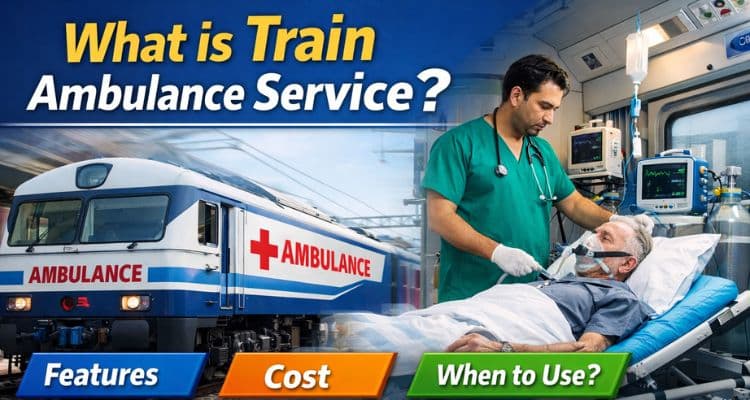
It is important to understand what a “train ambulance” actually is. A train ambulance is not a specialized, dedicated train; rather, private ambulance service providers book tickets in the First Class AC or Second Class AC coaches of the fastest available train.
On the day of travel, portable medical equipment—such as cardiac monitors, infusion pumps, suction machines, glucometers, and nebulizers—is installed within the designated coach.
In cases where the patient’s condition is critical, a ventilator or BiPAP machine is also provided.
Furthermore, if the patient requires oxygen, an oxygen cylinder is also carried along during the journey.
Think of it as a hospital room that moves at 130 km/h across India’s rail network.
The compartment is pre-equipped before the patient boards. By the time the train departs, the setup already includes:
- Ventilator support (for patients who cannot breathe independently)
- Cardiac monitors with continuous ECG tracking
- Pulse oximeters and blood pressure monitors
- IV infusion pumps for controlled medication delivery
- Suction machines
- Oxygen cylinders with backup supply
- Emergency drug kit (including resuscitation medicines)
- Stretcher and patient positioning equipment
And most critically — a trained medical team onboard: typically a doctor and a paramedic, monitoring the patient throughout the journey.
This is not a comfort upgrade. This is critical care in motion.
How It’s Different From What You’re Imagining
Most people, when they hear “patient on a train,” picture a general compartment with a blanket and a worried family member. That picture is dangerously incomplete.
Here’s what sets a professional train ambulance apart:
| Feature | Regular Train Travel | Train Ambulance Service |
| Medical Equipment | None | Full ICU setup |
| Medical Staff | None | Doctor + Paramedic |
| Compartment Type | Shared | Reserved/Private coupe |
| Patient Monitoring | None | Continuous, 24/7 |
| Emergency Response | None | Onboard + coordination with destination hospital |
| Booking Support | Self-arranged | Full coordination by provider |
The difference is not cosmetic. It is the difference between a patient surviving the journey and not.
The Three Kinds of Train Ambulance — Know Which One You Need
Not all patients are alike. Neither are train ambulance services. There are broadly three configurations:
ICU Train Ambulance (Critical Care on Rails)

For patients on ventilator support, those with multi-organ involvement, or anyone requiring continuous hemodynamic monitoring. This is the highest level of care available in train transport — equivalent to a Level 2 ICU room, mobile.
Ideal for: Post-surgical patients, ventilator-dependent patients, stroke patients being moved for ongoing rehabilitation, patients with cardiac instability.
Basic Life Support (BLS) Train Ambulance
For patients who are medically stable but still need supervision — someone recovering from surgery, a cancer patient traveling for chemotherapy at a distant center, or an elderly patient with chronic conditions needing monitoring.
Ideal for: Post-operative recovery transfers, dialysis patients, elderly patients with comorbidities.
Attendant-Assisted Transfer

For patients who are largely stable but need physical assistance and basic medical observation during travel. A trained attendant accompanies the patient, with basic monitoring equipment onboard.
Ideal for: Patients returning home after treatment, those with mobility limitations.
Choosing the wrong level of care is a serious mistake. A provider worth trusting will assess your patient’s condition before recommending any configuration.
When Does a Train Ambulance Make Sense? (And When It Doesn’t)
This is the most important section of this guide — because train ambulances are not for every situation.
Train Ambulance IS the Right Choice When:
- The distance is 500 km or more: Below 500 km, a road ambulance is usually faster when you factor in the time spent getting to the station and boarding. Beyond 500 km — especially on routes like Patna to Mumbai, Delhi to Chennai, or Kolkata to Hyderabad — the train ambulance becomes significantly more practical.
- The patient is stable but not fit for a road journey: A 12-hour road journey in a vehicle, even an ambulance, involves vibration, temperature changes, traffic stops, and physical strain. A train offers a stable, smooth platform that is far less taxing on a recovering body.
- Cost is a genuine constraint: Air ambulances in India typically cost between ₹5.5 lakhs and ₹12 lakhs depending on distance and aircraft type. A train ambulance for the same route costs a fraction — often 70–80% less — without compromising on medical safety.
- The patient is ventilator-dependent but not in acute distress: This surprises many families. Ventilator patients can travel by train — provided the right ICU setup, adequate oxygen backup, and an experienced medical team are onboard. This has been done successfully on routes across India.
- Time permits at least 24–48 hours for planning: A train ambulance requires booking tickets, arranging the compartment, setting up equipment, and coordinating with both origin and destination hospitals. Unlike a road ambulance that can depart in 30 minutes, a train ambulance requires lead time.
Train Ambulance is NOT the Right Choice When:
- It’s a true emergency with minutes mattering: Acute MI, stroke in the first 4–6 hours, major trauma, active hemorrhage — these require the fastest possible transport. That means a road ambulance to the nearest capable hospital, or an air ambulance if time and distance demand it.
- The patient’s condition is actively deteriorating: A train is not a place for a patient whose condition could worsen rapidly mid-journey and require interventions beyond what onboard staff can provide.
- The destination is not rail-connected: India’s railway network is vast but not universal. If your destination lacks a good railway connection with direct or easy train access, logistics become complicated.
Train Ambulance Service in Patna — What Families Need to Know
Patna sits at a unique crossroads. As the capital of Bihar, it is one of eastern India’s major referral hubs — but it also sends large numbers of patients outward to Delhi, Mumbai, Vellore, and Hyderabad for advanced care that isn’t available locally.
Train Ambulance Service in Patna is not just available — it is one of the most actively used services in the country for several reasons:
- Patna Junction is one of India’s busiest railway stations, with direct trains to virtually every major city
- The socioeconomic profile of Bihar means air ambulances are often financially out of reach
- Many patients come to Patna for initial stabilization, then need transfer to AIIMS Delhi or Mumbai’s Tata Memorial for further treatment
Key routes from Patna:
- Patna → Delhi (Rajdhani Express, ~17 hours) — ideal for patients needing AIIMS or Apollo Delhi
- Patna → Mumbai (~30 hours) — for oncology patients at Tata Memorial
- Patna → Kolkata (~8 hours) — for transfers to AMRI or Apollo Gleneagles
- Patna → Vellore (~36 hours) — for CMC Vellore transfers
For families in Patna requiring train ambulance service, the process begins with a call — a medical team assesses the patient and determines whether train transport is feasible, safe, and appropriate before any booking is made.
Also READ: How to Book a Train Ambulance in Hyderabad (Complete Guide 2026)
Train Ambulance Service in Delhi — The Hub That Connects India
Delhi is simultaneously India’s largest referral destination and origin point for patient transfers. Train Ambulance Service in Delhi operates across a complexity that few cities match.
Patients arrive in Delhi from Uttar Pradesh, Haryana, Rajasthan, Punjab, and Bihar seeking treatment at AIIMS, Safdarjung, Fortis, Max, and Apollo. Once treatment is complete — or if a decision is made to transfer to another center — the return journey begins.
What makes Delhi train ambulance operations unique:
- Multiple departure stations — Delhi has five major railway stations (New Delhi, Hazrat Nizamuddin, Old Delhi, Anand Vihar, Sarai Rohilla). An experienced provider knows which station connects best to your destination.
- Volume and availability — Delhi’s rail connectivity means there are multiple daily trains on most major routes, giving providers flexibility to find the earliest suitable departure.
- High-acuity transfers — Delhi’s hospitals handle India’s most complex cases, meaning many patients leaving Delhi are in serious condition and require ICU-level train setups.
Key routes from Delhi:
- Delhi → Mumbai (Rajdhani, ~16 hours) — among India’s busiest transfer routes
- Delhi → Chennai (~28 hours) — for transfers to Apollo, MIOT, or MGM hospitals
- Delhi → Patna — for post-treatment returns to Bihar
- Delhi → Kolkata (~17 hours via Rajdhani) — for transfers to eastern India hospitals
One critical advantage of choosing an established provider for Train Ambulance Service in Delhi is their ability to coordinate simultaneously with your departure hospital’s discharge team and your arrival hospital’s admission team — so the patient doesn’t fall through the cracks between two institutions.
Train Ambulance Service in Mumbai — When Cost Meets Distance
Mumbai is India’s financial capital — and also home to some of its most advanced cancer care, cardiac surgery, and transplant centers. Tata Memorial Centre, Kokilaben Dhirubhai Ambani Hospital, Hinduja Hospital, and Jaslok attract patients from across the subcontinent.
Train Ambulance Service in Mumbai serves two very distinct patient populations:
1. Patients arriving in Mumbai for treatment
Often coming from Madhya Pradesh, Rajasthan, Odisha, Bihar, and UP — families travel long distances with patients who need the specialized care only Mumbai offers.
2. Patients returning home after treatment
After weeks or months in Mumbai for chemotherapy, cardiac procedures, or organ transplants, patients need to return — often still fragile, still needing medical supervision.
Both situations are exactly what train ambulance services are built for.
Mumbai’s geography adds a layer of complexity — the city has two major railway terminus points (CST and Mumbai Central for Western Railway) and significant intra-city traffic. An experienced train ambulance provider managing Train Ambulance Service in Mumbai will handle:
- Road ambulance pickup from hospital to the correct station
- Equipment setup in the train compartment while you coordinate discharge
- Clear communication about platform and departure logistics
- Connection with a receiving ambulance at the destination city
Key routes from Mumbai:
- Mumbai → Delhi (~16–17 hours via Rajdhani)
- Mumbai → Patna (~30–33 hours) — one of the most commonly requested routes
- Mumbai → Nagpur (~8–9 hours)
- Mumbai → Hyderabad (~14 hours)
The Real Cost of Train Ambulance in India
This is where most articles fail their readers. Let’s be direct.
Train ambulance costs in India depend on four variables: distance, medical configuration, staffing, and train class. Here’s a realistic breakdown:
| Route | Approximate Distance | BLS Setup | ICU Setup |
| Patna → Delhi | ~1,000 km | ₹35,000–₹45,000 | ₹50,000–₹80,000 |
| Delhi → Mumbai | ~1,400 km | ₹45,000–₹55,000 | ₹65,000–₹1,00,000 |
| Mumbai → Patna | ~1,700 km | ₹40,000–₹60,000 | ₹75,000–₹1,10,000 |
| Patna → Kolkata | ~600 km | ₹35,000–₹45,000 | ₹45,000–₹55,000 |
| Delhi → Chennai | ~2,200 km | ₹55,000–₹75,000 | ₹90,000–₹1,40,000 |
These figures include:
- Train tickets (typically coupe/cabin in AC class)
- Medical equipment setup and usage
- Doctor and paramedic fees
- 24/7 patient monitoring during journey
- Coordination support
These figures do NOT include:
- Road ambulance at origin (pickup from hospital to station)
- Road ambulance at destination (station to hospital)
- Specialized medications or consumables beyond standard kit
- Extended layovers or connecting train arrangements
Compare this to air ambulance:
The same Patna–Delhi route by air ambulance would cost ₹5,50,000–₹7,00,000. The Delhi–Mumbai route can exceed ₹9,00,000.
The train ambulance is not a compromise. It is a rational, medically sound decision for stable patients who need safe long-distance transport.
Step-by-Step: What Actually Happens When You Book a Train Ambulance
Most families have never done this before and have no idea what to expect. Here is the actual sequence:
Step 1 — First Contact (30 minutes)
You call the provider and share: patient’s current condition, current location (hospital name and city), destination city and hospital, and approximate timeline. A coordinator takes notes and loops in a medical team.
Step 2 — Medical Assessment (1–2 hours)
A doctor reviews the patient’s current reports — vitals, diagnosis, current medications, ventilator settings if applicable — and gives a transport fitness assessment. This determines whether train transport is safe and what level of setup is required.
Step 3 — Logistics Planning (2–4 hours)
The team identifies the best train for your route (direct, shortest travel time, appropriate class availability), books tickets, and begins equipment preparation.
Step 4 — Equipment Setup (2–3 hours before departure)
The medical team arrives at the station early. They load equipment into the reserved compartment and configure the ICU setup before the patient arrives.
Step 5 — Patient Transfer to Station
A road ambulance transfers the patient from hospital to station. This is coordinated carefully — timing the hospital discharge, travel to station, and boarding without disrupting the patient’s medical stability.
Step 6 — Boarding and Departure
The patient is transferred to the train compartment on a stretcher. The medical team does a baseline check of all vitals, confirms equipment is functioning, and the journey begins.
Step 7 — In-Transit Care
The medical team monitors the patient continuously throughout the journey. All observations are logged. The coordination team at the provider’s office remains reachable for any guidance needed.
Step 8 — Arrival and Handover
A road ambulance from the destination city is pre-arranged and waiting at the platform. The patient is transferred and taken to the receiving hospital. The medical team provides a complete handover report to the destination hospital’s team.
Safety Standards — What to Demand From Any Provider
Not all train ambulance providers operate at the same standard. When evaluating a provider, ask these specific questions:
About equipment:
- Is the ventilator transport-grade (not hospital-based units that require AC power)?
- How many hours of backup oxygen do you carry?
- Is the cardiac monitor capable of continuous recording, or just spot-checks?
About staff:
- Is the onboard doctor an MBBS minimum, or a paramedic posing as a doctor?
- Does the paramedic have Basic Life Support (BLS) or Advanced Cardiac Life Support (ACLS) certification?
- What is the protocol if the patient deteriorates mid-journey?
About coordination:
- Do you coordinate with both origin and destination hospitals directly?
- Is there a 24/7 coordination team reachable during the journey?
- Do you arrange the road ambulance at both ends?
About transparency:
- Is pricing quoted all-inclusive or will there be add-ons later?
- Can you provide references from past patients or families?
A provider who hesitates on any of these questions is not the one to trust with your patient.
A Real Transfer: Ventilator Patient, Bangalore to Kolkata
To make this concrete, here is a representative account of what a successful train ambulance transfer looks like.
Patient profile: 67-year-old male, post-ICU care following respiratory failure. On ventilator, stable but dependent. Family in Kolkata; patient had been admitted in Bangalore.
The challenge: Air ambulance quote was ₹5.5 lakhs — beyond the family’s means. Road ambulance would have been 48+ hours of travel, an impossibility for a ventilator patient.
The solution: ICU train ambulance arranged on the Bangalore–Kolkata route. The train journey: approximately 36 hours.
The setup: Transport ventilator with 48-hour backup oxygen supply. Cardiac monitor, suction machine, infusion pump. One doctor and one paramedic onboard throughout.
The outcome: Patient arrived in Kolkata in stable condition. Handover to Apollo Gleneagles ICU team completed without incident.
The cost: Approximately ₹75,000 — compared to ₹6.5 lakhs by air.
This is not an exceptional case. This is what a well-executed train ambulance service does routinely.
Common Questions — Answered Directly
Can a patient on a ventilator really travel by train?
Yes — with a transport-grade ventilator, adequate oxygen supply, and an experienced medical team onboard. This is done regularly by established providers.
How quickly can a train ambulance be arranged?
Typically 12–24 hours from the first call, depending on train availability on your route. In some cases with flexible timing, it can be arranged within 6–8 hours.
What documents do I need?
Current medical reports and discharge summary (or treating doctor’s note), patient ID proof, and a relative’s ID. The provider’s coordination team will guide you through specifics.
Is there any government-run train ambulance service?
Indian Railways provides the network infrastructure and has provisions for emergency travel, but does not operate ICU-equipped train ambulances. These are operated by private medical transport providers.
Does insurance cover train ambulance?
Some health insurance policies cover medical transport — check your policy for “ambulance charges” or “medical evacuation” clauses. The provider can typically issue documentation for insurance claims.
What if the patient’s condition worsens during the journey?
The onboard medical team manages the situation using available equipment and medications. Simultaneously, the coordination team arranges emergency support at the nearest station city if evacuation becomes necessary. This is why having an experienced team — not just a nurse with a first aid kit — is non-negotiable.
How to Choose the Right Train Ambulance Provider
India has many train ambulance providers, ranging from highly professional operations to agents who overstate their capabilities. Here is how to tell the difference:
Green flags:
- Transparent, itemized pricing with no vague “extra charges may apply”
- Medical team assessment before confirming transport feasibility
- Clear documentation of equipment carried
- Verifiable track record with patient references available
- 24/7 availability with a dedicated coordination team
- Coordination with both origin and destination hospitals
Red flags:
- Quoting a price before asking about the patient’s condition
- Unable to specify which ventilator model they use
- No doctor — only a paramedic — for ICU transfers
- Pressure to book immediately before assessment is complete
- No road ambulance coordination at either end
The Bottom Line
Train ambulance services occupy a critical and often overlooked space in India’s healthcare ecosystem. They are not a last resort. They are not a compromise. For the right patient — stable, requiring long-distance transfer, with cost as a genuine concern — a train ambulance is often the best choice.
Whether you need a Train Ambulance Service in Patna to bring a family member home from Delhi, a Train Ambulance Service in Delhi for a transfer to Chennai or Mumbai, or a Train Ambulance Service in Mumbai for a patient returning to eastern India after treatment, the service exists, it works, and it saves families both money and heartbreak.
The key is choosing a provider who puts medical safety first — not one who puts booking confirmations first.
Need Immediate Assistance?
Save Life Care provides ICU-equipped train ambulance service across all major routes in India, including Patna, Delhi, Mumbai, Kolkata, Chennai, Hyderabad, Bangalore, and beyond.
- 24/7 medical coordination
- Experienced doctors and paramedics onboard
- Transparent, all-inclusive pricing
- ICU-grade equipment for ventilator and critical patients
- Road ambulance coordination at both ends
- Call or WhatsApp: +91-8083309381
Available 24 hours. Medical assessment provided before any booking confirmation.