Your loved one needs to be shifted to a hospital in another city. The doctors say it’s urgent. You’ve heard of train ambulances but have no idea where to start. You’re not alone — and this guide is written exactly for you.
Hyderabad is one of India’s top medical hubs, home to world-class hospitals like Apollo, Yashoda, CARE, and KIMS. But there are times when a patient needs to be transferred out — to Delhi for specialist surgery, to Mumbai for oncology, or to Chennai for a transplant. In both situations, a train ambulance is often the safest, most affordable, and most practical solution for long-distance patient transport.
What Is a Train Ambulance?
A train ambulance — also called a rail ambulance — is a specially configured railway coach equipped with ICU-level medical facilities and staffed by trained doctors, nurses, and paramedics. Think of it as a mobile hospital ward on rails.
Unlike a regular compartment, a train ambulance coach carries life-support equipment for continuous critical care throughout the journey:
- Ventilators and oxygen cylinders
- Cardiac monitors and defibrillators
- Infusion pumps and suction machines
- Multi-parameter patient monitors
- Emergency medicines and resuscitation kits
The entire journey — sometimes 12 to 36 hours — is managed by a medical team monitoring the patient continuously. Family members can also travel in the same coach, which is something air ambulances rarely allow.
In simple words: A train ambulance gives you hospital-level critical care at a fraction of the cost of an air ambulance, while keeping your family together during the journey.
When Should You Consider a Train Ambulance?
Not every situation calls for a train ambulance. Here’s when it makes the most sense:
- The patient needs to travel more than 400 km
- The condition is serious but stable enough for rail travel (doctor-assessed)
- You need ICU-level care en route, not just basic oxygen support
- An air ambulance is too expensive or unavailable
- Road transport over that distance would be too exhausting or risky for the patient
- The patient is post-surgery and needs careful, smooth transport
- The patient is ventilator-dependent and needs continuous monitoring
Train ambulances are not ideal for extremely critical patients who need to reach a hospital within 2–3 hours. In that case, an air ambulance may be the only option. A qualified provider will assess this before booking.
How to Book a Train Ambulance in Hyderabad (Step-by-Step)
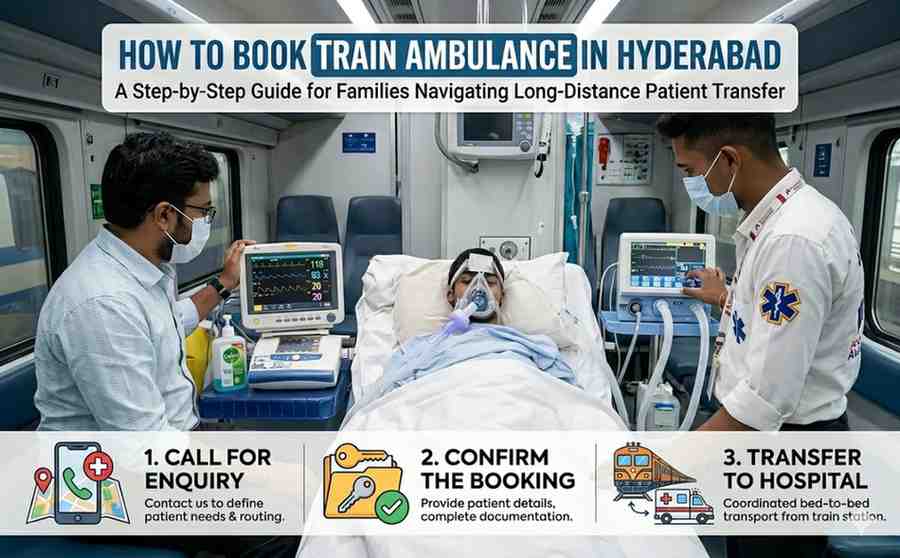
The process is simpler than most people expect. Here’s exactly how it works, start to finish:
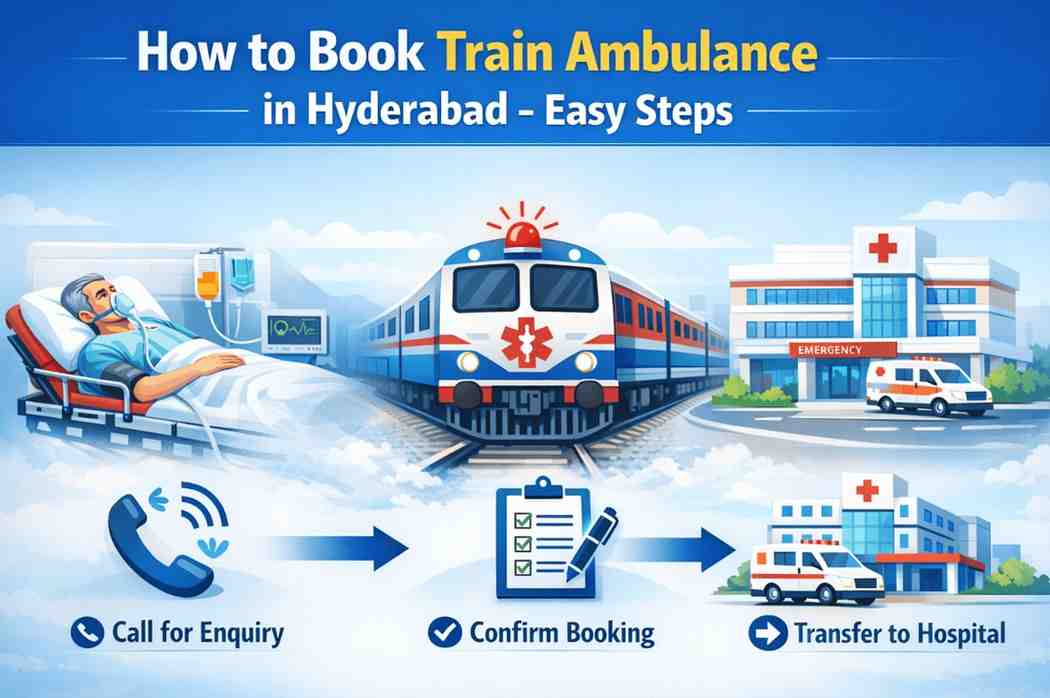
1. Call a Train Ambulance Service Provider
Your first step is to call a provider that operates in Hyderabad. Most run 24/7 helplines. Have ready: the patient’s name and age, current hospital or location, their medical diagnosis, the destination city and hospital, and any specific equipment required (ventilator, cardiac monitor, oxygen, etc.).
2. Medical Assessment of the Patient
Once you share the details, the provider’s medical team assesses whether the patient is fit for train travel. They evaluate current vitals, diagnosis, and stability. Based on this, they’ll recommend the right support level: basic setup, semi-ICU, or full ICU train ambulance.
3. Train and Berth Arrangement
The provider coordinates with Indian Railways to arrange a dedicated medical compartment — typically AC 1st class or AC 2-tier. This step requires a minimum of 24 hours since railway scheduling must be confirmed. The earlier you call, the better your options.
4. Road Ambulance Pickup (Bed-to-Bed Transfer)
Most reputable providers offer full bed-to-bed service. A road ambulance picks the patient from their hospital bed and transports them to the nearest station — Secunderabad, Hyderabad Deccan (Nampally), or Kacheguda. You don’t arrange anything separately.
5. The Journey with Continuous Medical Care
Throughout the journey, ICU-trained doctors, nurses, and paramedics monitor the patient non-stop. The coach carries all life-support systems and emergency drugs. Family members travel alongside. The environment is calm, spacious, and air-conditioned.
6. Safe Handover at the Destination Hospital
On arrival, a road ambulance receives the patient from the train and transfers them to the receiving hospital. The medical team provides a detailed handover report — covering vitals, medications, and observations — ensuring zero gap in care.
Patients from These Hospitals Can Be Transferred
If your loved one is currently admitted at any of these hospitals and needs to be moved to another city for advanced care, the train ambulance team coordinates the entire process — from hospital bed to train to destination hospital.
| Hospital | Location | Known For |
| Apollo Hospitals | Jubilee Hills | Cardiac care, transplants, oncology |
| Yashoda Hospitals | Somajiguda / Secunderabad / Malakpet / HITEC City | Multi-specialty, 2,756+ beds |
| CARE Hospitals | Banjara Hills / HITEC City / Nampally | Emergency care, nephrology, cardiology |
| KIMS Hospitals | Secunderabad | Neurology, cardiology, orthopaedics |
| Kamineni Hospital | King Koti / LB Nagar | Multi-specialty critical care |
| Aware Gleneagles Global | Bairamalguda | Multi-specialty, critical care |
| Star Hospitals | Banjara Hills | NABH accredited, multi-specialty |
| Rainbow Children’s Hospital | Banjara Hills | Paediatric critical care transfers |
| NIMS | Punjagutta | Government tertiary care hospital |
| Osmania General Hospital | Afzalgunj | Largest public hospital in Hyderabad |
| PACE Hospital | Madinaguda | Multi-specialty, cardiac focus |
| Ankura Hospital | Banjara Hills | Women and children specialists |
What Does a Train Ambulance Cost from Hyderabad?
The cost depends on several key factors:
- Distance — longer routes cost more due to extended travel and medical supervision
- Type of medical setup — semi-ICU vs full ICU configuration
- Medical equipment required — ventilator, cardiac monitor, oxygen, etc.
- Medical team size — doctor + nurse + paramedic, or nurse + paramedic only
- Train type — Rajdhani or Duronto trains are faster but slightly costlier
- Berth class — AC 1st class (1AC) vs AC 2-tier (2AC)
| Route | Semi-ICU (Approx.) | Full ICU (Approx.) |
| Hyderabad → Delhi | Rs. 70,000 – Rs. 85,000 | Rs. 85,000 – Rs. 1,10,000 |
| Hyderabad → Mumbai | Rs. 55,000 – Rs. 70,000 | Rs. 70,000 – Rs. 90,000 |
| Hyderabad → Kolkata | Rs. 65,000 – Rs. 80,000 | Rs. 80,000 – Rs. 1,00,000 |
| Hyderabad → Chennai | Rs. 40,000 – Rs. 55,000 | Rs. 55,000 – Rs. 75,000 |
| Hyderabad → Bangalore | Rs. 35,000 – Rs. 50,000 | Rs. 50,000 – Rs. 70,000 |
| Hyderabad → Patna | Rs. 75,000 – Rs. 90,000 | Rs. 90,000 – Rs. 1,15,000 |
| Hyderabad → Pune | Rs. 45,000 – Rs. 60,000 | Rs. 60,000 – Rs. 80,000 |
| Hyderabad → Nagpur | Rs. 45,000 – Rs. 65,000 | Rs. 65,000 – Rs. 70,000 |
Note: These are indicative estimates based on 2026 market rates. Actual costs vary by patient condition, urgency, and provider. Always ask for a clear written quote with no hidden charges before confirming.
Train Ambulance vs Air Ambulance
This is the most common dilemma families face. Here’s an honest, side-by-side comparison:
| Factor | Train Ambulance | Air Ambulance |
| Cost | Rs. 45,000 – Rs. 1,15,000 | Rs. 7 Lakh – Rs. 10+ Lakh |
| Speed | 12–36 hours | 1–3 hours |
| Medical Facilities | Full ICU-level care | Full ICU-level care |
| Family Travel | Yes | Usually No |
| Best For | Stable critical patients | Extreme emergencies |
| Advance Notice | Min. 24 hours | 4–8 hours |
| Patient Comfort | Spacious, smooth ride | Turbulence possible |
| Coverage | Pan-India rail network | Limited to airports |
The bottom line: if the patient is in a time-critical emergency and cost is not a concern, an air ambulance makes sense. But if the patient is stable and you have at least 24 hours, a train ambulance provides the same ICU care at roughly 8–10% of the air ambulance cost — and you can be right there beside them throughout the journey.
Also Read: Train Ambulance Services in Bangalore: Affordable and Reliable Medical Transfers
Dead Body Transport by Air Cost in India: Complete Guide (2025)
Quick Checklist Before You Book
Having this information ready when you call will speed up the entire process significantly.
Before You Make That Call, Have This Ready:
- Patient’s full name, age, and weight
- Current hospital name and ward/room number
- Diagnosis and current medical condition
- Attending doctor’s name and contact (for coordination)
- Destination city and receiving hospital (if decided)
- List of current medications and equipment in use
- Whether the patient is on a ventilator or needs oxygen
- Number of family members travelling alongside
- Preferred departure date and time (if not urgent)
- Budget range (so provider can suggest the right setup)
Frequently Asked Questions
These are the questions most families ask before booking — kept strictly relevant to train ambulance booking in Hyderabad.
Q: How do I book a train ambulance in Hyderabad?
A: Call a train ambulance service provider’s 24/7 helpline with the patient’s details — their condition, current hospital, and destination city. The team will assess the patient, arrange a railway coach, and coordinate road ambulance pickup. Most providers also allow booking via WhatsApp. Expect at least 24 hours of lead time for railway arrangement.
Q: What is the cost of a train ambulance from Hyderabad?
A: Train ambulance costs from Hyderabad range from Rs. 45,000 (shorter routes like Hyderabad–Bangalore) to Rs. 1,15,000 (longer routes like Hyderabad–Patna or Hyderabad–Delhi) depending on distance, ICU setup type, and medical team. This is significantly more affordable than an air ambulance, which costs Rs. 7 lakh to Rs. 10+ lakh for the same routes. Always ask for a transparent quote with no hidden charges.
Q: How much does an air ambulance cost from Hyderabad?
A: Air ambulances from Hyderabad are significantly more expensive. Hyderabad to Delhi typically costs Rs. 7.7 lakh to Rs. 8.5 lakh, and Hyderabad to Mumbai ranges from Rs. 7.5 lakh to Rs. 8.5 lakh. If your patient’s condition allows for a 24-hour window, a train ambulance provides the same ICU-level care at roughly 8–10% of the air ambulance cost.
Q: Can critically ill or ventilator-dependent patients travel by train ambulance?
A: Yes, in many cases. Train ambulance coaches carry ventilators, defibrillators, cardiac monitors, and ICU-trained doctors who manage critically ill patients throughout the journey. However, whether a specific patient is fit for rail travel depends on their condition. The provider’s medical team assesses this before confirming the booking — patient safety always comes first.
Q: How long does it take to arrange a train ambulance in Hyderabad?
A: Most providers require a minimum of 24 hours to arrange the railway coach, medical team, and berth booking. In some cases, expedited coordination is possible within 12–16 hours. For non-urgent transfers, booking 48–72 hours in advance gives better options for train timing and berth class.
Q: Can family members travel with the patient?
A: Yes — this is one of the biggest advantages over air ambulances. Family members can travel in the same coach alongside the patient, providing emotional support during the journey. Most providers include one attendant seat in the package, with additional seats available if needed.
Q: Which railway stations in Hyderabad are used for departures?
A: Hyderabad has three major stations used for train ambulance departures: Secunderabad Junction (the largest), Hyderabad Deccan (Nampally), and Kacheguda. The choice depends on which trains serve your destination route. The road ambulance takes the patient to whichever station is most appropriate for the booked train.
Q: Which cities can patients be transferred to from Hyderabad?
A: Hyderabad is well-connected by Indian Railways, making train ambulance transfers possible to virtually any major city — including Delhi, Mumbai, Kolkata, Chennai, Bangalore, Patna, Pune, Nagpur, Jaipur, Bhopal, Varanasi, Guwahati, Ranchi, Bhubaneswar, and more. If the destination city has a railway station, a transfer can almost certainly be arranged.
Final Word
Medical emergencies are stressful enough without the added confusion of figuring out how to transport your loved one safely across hundreds of kilometres. A train ambulance removes much of that burden — you make one call, and a trained team handles the rest.
What matters most is acting quickly. The sooner you contact a provider, the more options they have for train timing, berth availability, and medical team assignment. Even if you’re not 100% sure yet, an initial call costs nothing and gives you clarity.
Your loved one deserves safe, dignified, expert care — every kilometre of the way.