When a loved one is critically ill, every decision feels heavy. For many families in Patna and across Bihar, the most difficult moment comes when doctors say, “The patient needs to be shifted to a higher medical facility in another city.”
The first thought is not distance or paperwork — it is fear.
- Will the patient remain stable during the journey?
- What if something goes wrong on the way?
- How can ICU care continue outside the hospital?
This is where Train Ambulance Services in Patna become a crucial lifeline for critical patient transfers. Designed specifically for long-distance critical patient transfers, train ambulances ensure that medical care does not stop even for a moment. They transform a railway journey into a moving ICU, focused entirely on patient safety and continuity of treatment.
Why Critical Patients in Patna Often Need to Be Shifted
Patna is a major medical hub in Bihar, yet many complex cases still require referral to metro cities like Delhi, Kolkata, Mumbai, or Chennai. This is common in situations such as:
- Severe brain stroke or head injury
- Advanced cardiac conditions
- Multiple organ failure
- Cancer complications
- Post-surgery critical care
- Ventilator-dependent patients
In these cases, doctors do not recommend travel unless it is absolutely necessary. When they do, the method of transport becomes as important as the treatment itself.
What Is a Train Ambulance? (And What It Is Not)
A common misunderstanding is that a train ambulance is just a patient lying on a train berth. That is not true.
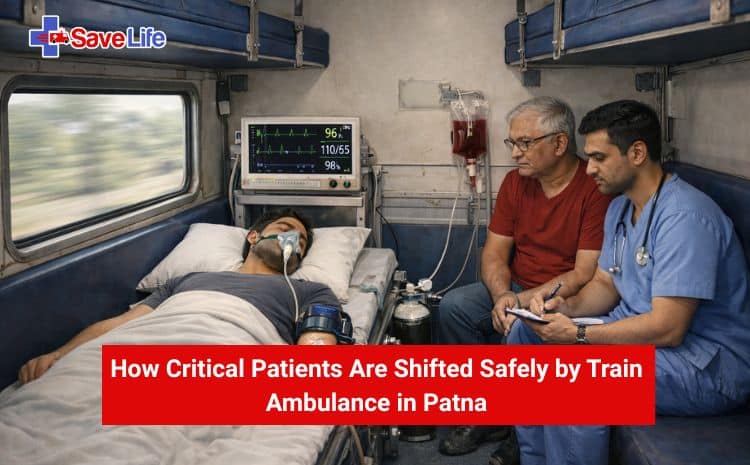
A train ambulance is a medically supervised patient transfer service that uses reserved railway berths or coaches converted into a fully functional mobile ICU. It is equipped with advanced life-support systems and managed by trained medical professionals.
How it is different from:
- Normal train travel: No medical monitoring, no emergency support
- Road ambulance: Risky for long distances, traffic delays, physical stress
- Train ambulance: Stable, spacious, medically controlled environment
This makes train ambulances ideal for long-distance critical transfers from Patna.
Step-by-Step: How a Critical Patient Is Shifted Safely by Train Ambulance
Understanding the process reduces fear. Here is exactly how a critical patient is shifted safely by a train ambulance from Patna.
1. Medical Assessment Before the Journey
The process begins with a detailed medical evaluation. Doctors review:
- Current diagnosis
- Vital stability
- Oxygen or ventilator dependency
- Risk factors during travel
Based on this assessment, the required ICU equipment and medical staff are planned. This ensures the patient is fully prepared for the journey before leaving the hospital.
2. Bed-to-Bed Transfer from Hospital or Home
Once everything is arranged:
- An ICU-equipped road ambulance arrives at the patient’s location
- The patient is shifted on a stretcher with oxygen and monitoring
- Continuous medical supervision is maintained
This step is critical because there is no gap in care — from hospital bed to ambulance to train.
3. Medical Setup Inside the Train
At Patna railway station, the medical team prepares the reserved train space before the patient boards.
This includes:
- Securing the stretcher or ICU bed
- Installing ventilator, oxygen cylinders, monitors
- Checking emergency medicines and backup equipment
- Ensuring patient comfort and safety
Family members are usually seated nearby so they can remain close to the patient during the journey.
4. Continuous Monitoring During the Train Journey
This is the biggest advantage of a train ambulance.
Throughout the journey:
- A trained doctor, nurse, or paramedic stays with the patient
- Vitals such as heart rate, oxygen levels, BP are monitored continuously
- Medications are administered on time
- Any emergency is handled immediately
Train travel offers a smooth and stable environment, which is often safer for fragile patients compared to long road journeys.
5. Safe Handover at the Destination Hospital
Before the train reaches the destination:
- A receiving ICU road ambulance is kept ready
- The medical team coordinates with the destination hospital
After arrival:
- The patient is shifted directly to the hospital ICU
- A complete medical handover is given to hospital doctors
This ensures zero disruption in treatment.
Medical Equipment Available in a Train Ambulance
A train ambulance from Patna is equipped to handle critical conditions. Depending on patient needs, the setup may include:
- Ventilator support
- Oxygen cylinders with backup
- Cardiac monitor
- Infusion and syringe pumps
- Suction machine
- Emergency medicines
- Defibrillator (if required)
This allows ICU-level care to continue for the entire journey.
Who Can Safely Travel by Train Ambulance?
Train ambulances are suitable for patients who:
- Are critically ill but medically stable for transfer
- Require oxygen or ventilator support
- Need long-distance hospital transfer
- Are post-surgery and need specialized care
- Cannot tolerate long road journeys
Doctors determine suitability after medical evaluation.
Why Train Ambulance Is Safer Than Road for Long Distances
For journeys of 10–30 hours or more, road ambulances can become physically stressful due to:
- Continuous vibration
- Traffic delays
- Limited space
- Fatigue for patient and medical staff
Train ambulances provide:
- Better space for medical equipment
- Smooth, predictable travel
- No traffic interruptions
- Lower physical stress on patients
For families in Bihar, it is also a cost-effective alternative to air ambulances.
Emotional & Practical Support for Families
Beyond medical care, train ambulances provide something equally important — emotional reassurance.
- One family member is permitted to accompany the patient during the journey.
- Medical staff communicate regularly about patient condition
- Families are guided at every step
- Patients are treated with dignity and compassion
This human touch matters deeply during critical times.
Common Fears Families Have (Answered Honestly)
What if the patient’s condition worsens?
Medical staff are present throughout to manage emergencies.
Is oxygen enough for such a long journey?
Oxygen is planned with backup cylinders based on duration.
Are doctors really available onboard?
Yes, trained medical professionals travel with the patient.
Is this safe for ICU patients?
Yes, when medically assessed and properly planned.
How to Arrange a Train Ambulance in Patna
To arrange a train ambulance quickly, families usually need:
- Patient medical reports
- Doctor’s referral or advice
- Destination hospital details
Experienced train ambulance providers handle:
- Railway coordination
- Medical logistics
- Bed-to-bed transfer planning
- 24/7 support
Early coordination helps avoid delays.
Conclusion: Care That Travels with the Patient
For families facing a medical emergency, shifting a critical patient is never just about distance — it is about trust, safety, and continuity of care.
A Train Ambulance Service in Patna ensures that critical patients are not merely transported, but medically protected throughout the journey. With trained professionals, ICU-level equipment, and a carefully planned process, train ambulances serve as a lifeline for patients who need advanced care beyond city limits.
When hospitals change, care should not stop — and with train ambulances, it doesn’t.