
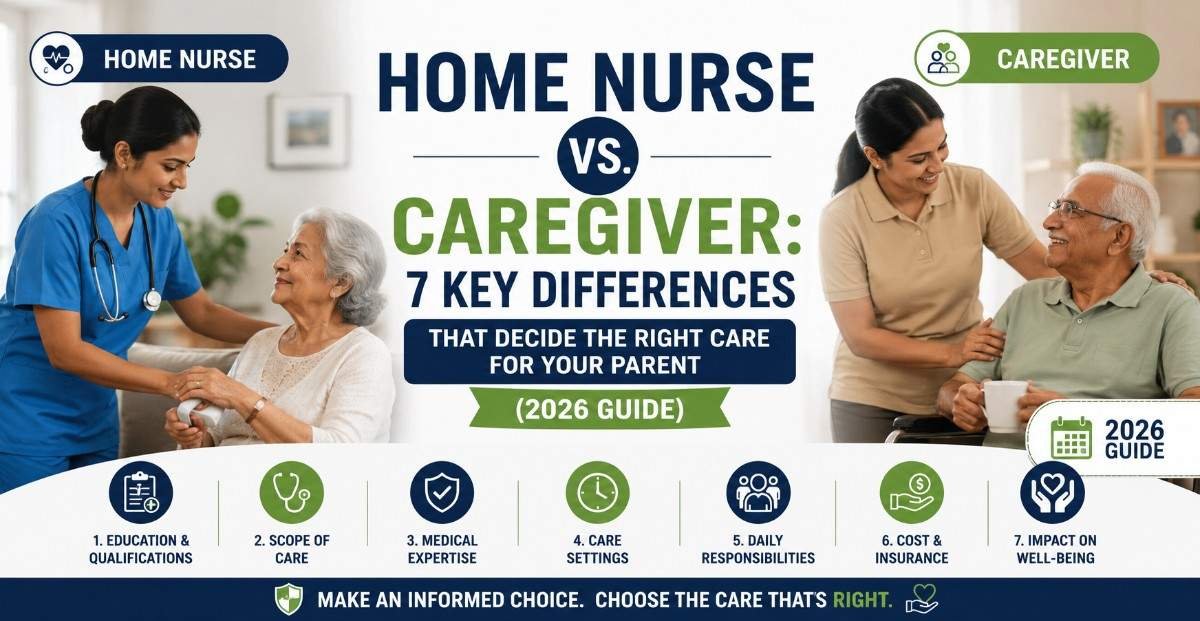
Choosing the wrong type of home care can delay a parent’s recovery — or quietly cost a family ₹15,000 or more a month in services they didn’t actually need. It’s one of the most common mistakes families make right after a hospital discharge.
If you’ve just brought a parent home from the hospital, or you’re watching them manage a chronic illness on their own, you’ve probably heard the words “nurse,” “caregiver,” and “attendant” used like they mean the same thing. They don’t — and getting this wrong can mean either paying for clinical skills you don’t need, or worse, missing clinical care your parent actually requires.
In this guide, you’ll discover exactly what separates a home nurse from a home caregiver, what each one costs in India, and how to decide which one your parent needs — without guessing or relying on a hospital’s rushed discharge advice.
Save Life Care has supported 1,000+ families across India with home nursing and home care services, maintaining a 99%+ client satisfaction rate, and this guide reflects the patterns we see most often when families are making this exact decision.
What Is a Home Caregiver?
A home caregiver is the right choice when a parent is medically stable but needs daily support to live safely and comfortably at home.
A home caregiver is a trained non-medical support worker who helps with daily living activities. They work by assisting with bathing, dressing, feeding, mobility, and companionship. Most commonly used for elderly parents who are stable but unable to manage daily tasks alone.
Caregivers are especially valuable for families dealing with general age-related frailty, mild memory issues, or recovery from a minor illness where the main need is supervision and physical assistance rather than medical treatment.
What a Caregiver Can’t Do
Caregivers are not legally permitted to perform clinical tasks. That means no injections, no wound dressing, no medication administration beyond simple reminders, and no managing of medical equipment like catheters, feeding tubes, or oxygen concentrators. If your parent needs any of these, a caregiver alone isn’t enough.
What Is a Home Nurse?
A home nurse becomes necessary the moment medical or post-procedure care enters the picture.
A home nurse is a clinically trained professional, typically holding a GNM, BSc Nursing, or ANM qualification. They work by performing medical tasks such as administering injections, managing wounds, monitoring vitals, and operating equipment like Ryles tubes or catheters. Most commonly used for post-surgical recovery, chronic disease management, or bedridden patients.
Home nurses are trained to recognise early warning signs — a spike in blood pressure, an infected wound, irregular breathing — and respond appropriately or escalate to a doctor, which is something a non-medical caregiver is not trained or authorised to do.
MUST READ: Home Nursing Care Services at Home: Complete Guide
When a Nurse Is Medically Required
- Recovery after surgery (cardiac, orthopaedic, abdominal)
- Management of diabetes, paralysis, or stroke aftercare
- Patients on ventilators, oxygen support, or tube feeding
- Palliative or end-of-life care requiring symptom management
Home Nurse vs Caregiver — Side-by-Side Comparison
| Factor | Home Caregiver | Home Nurse |
| Qualification | Basic caregiving training | GNM / BSc Nursing / ANM |
| Tasks | Bathing, feeding, mobility, companionship | Injections, wound care, vitals, tube/catheter care |
| Best for | Stable elderly parents needing daily support | Post-surgery, chronic illness, bedridden patients |
| Typical cost (India) | ₹18,000–₹30,000/month (live-in) | ₹35,000–₹60,000+/month, or ₹1,200–₹2,500/shift |
In short: a caregiver supports daily life, while a nurse manages medical needs. The deciding factor isn’t age or how unwell someone “seems” — it’s whether the care involves a clinical procedure.
The 7 Key Differences at a Glance
- Qualification — Caregivers have basic, non-medical training; nurses hold a GNM, BSc Nursing, or ANM degree.
- Legal scope — Caregivers cannot legally perform clinical procedures; nurses can.
- Daily tasks — Caregivers focus on bathing, feeding, and mobility; nurses focus on injections, wound care, and vitals monitoring.
- Medical equipment — Caregivers cannot manage catheters, feeding tubes, or oxygen concentrators; nurses are trained to.
- Emergency response — Caregivers can alert family or call for help; nurses can recognise clinical warning signs and intervene directly.
- Typical use case — Caregivers suit stable elderly parents; nurses suit post-surgical, chronic illness, or bedridden patients.
- Cost — Caregivers are generally more affordable (₹18,000–₹30,000/month); nurses cost more (₹35,000–₹60,000+/month) due to their clinical training.
MUST READ: Elderly Care at Home: How to Take Care of Seniors Safely and Comfortably
How Do You Decide Which One Your Parent Needs?
The simplest test is to ask: does my parent need help living, or help with a medical condition?
If the answer involves wound care, injections, monitoring vitals after surgery, or managing a feeding tube or catheter, a nurse is required — not optional. If the need is purely physical assistance, supervision, and companionship for someone who is otherwise stable, a caregiver is sufficient and more cost-effective.
When You Need Both
Many families end up needing a combination — for example, a nurse for a few hours a day to handle dressing changes and medication, with a caregiver covering the remaining hours for companionship and daily support. This hybrid model is common for stroke recovery and long-term bedridden care, and it’s usually more affordable than running 24-hour nursing care.
ALSO READ: Complete Home Nursing Services in Patna by Save Life
What Does It Cost in India? (Insurance & Cashless Considerations)
Costs vary by city and duration of care, but as a general range: live-in caregivers typically cost ₹18,000–₹30,000 per month, while home nurses range from ₹1,200–₹2,500 per shift, or ₹35,000–₹60,000+ per month for full-time care.
Cashless hospitalization and health insurance in India typically cover in-hospital treatment, not ongoing home nursing or caregiving. Some insurers offer limited home healthcare riders or post-hospitalization domiciliary cover — it’s worth checking your policy document or calling your insurer directly before assuming home care costs will be reimbursed.
A practical tip: if your parent’s discharge summary recommends home nursing, ask the hospital for a written care plan. Some insurers will partially reimburse domiciliary care if it’s clearly tied to a recent hospitalization.
Common Mistakes Families Make When Choosing Home Care
- Hiring a caregiver for a medical need. This is the single most common and most dangerous mistake — and the one we see most often at the point a wound infection or missed medication is discovered too late.
- Skipping background verification. Always confirm ID, address proof, and prior work references before someone enters your parent’s home.
- No clear handover process. When shifts change, there should be a written log of medication, vitals, and any incidents — verbal handovers get forgotten.
- Assuming insurance covers it. Confirm coverage in writing before committing to a long-term care plan.
What We’ve Learned From 1,000+ Families
“The families who struggle most aren’t the ones with the most complex medical cases — they’re the ones who didn’t know they needed a nurse instead of a caregiver until something went wrong.” — Clinical Lead, Save Life Care, 2026
One pattern we see repeatedly: families default to hiring a caregiver first because it’s cheaper, then upgrade to a nurse only after a complication — a missed medication, an infected wound, a fall that could have been caught earlier with clinical monitoring. Getting the right assessment done before hiring, rather than after, is consistently what separates a smooth recovery from a difficult one.
Conclusion
The difference between a home caregiver and a home nurse comes down to one question: does your parent need daily living support, or clinical medical care? Caregivers are ideal for stable elderly parents who need help with daily tasks, while nurses are essential for post-surgical recovery, chronic illness, and any situation involving medical procedures. When in doubt, a quick clinical assessment can save you from an expensive — or risky — mismatch.
Get the Right Care, Without the Guesswork
Not sure which type of care your parent needs? Call +91-8083309381 to speak with a care advisor and get matched with the right type of care — nurse or caregiver — based on your parent’s actual condition.
About the Author
Save Life Care Team, reviewed by a Registered Nursing Supervisor. Save Life Care has supported 1,000+ families across India with home nursing and home care services, maintaining a 99%+ client satisfaction rate.